A cookie recipe can seem inexpensive until you count the ingredients you actually use, packaging, labor, and per-order costs. A small costing sheet helps you see the numbers before you choose a selling price.
Start with the quantity used, not the package price
For each ingredient, record the quantity purchased, the purchase price, and the quantity used in one batch. The ingredient cost for that batch is purchase price × (quantity used ÷ quantity purchased), provided both quantities use the same unit.
For example, if 1,000 grams of flour cost $2.40 and the recipe uses 250 grams, the flour cost is $0.60. Repeat that calculation for sugar, butter, chocolate, eggs, and any other ingredients. Converting everything to matching units avoids common errors such as dividing grams by kilograms without converting first.
If you buy ingredients in several sizes, do not average package prices blindly. Use the actual usable quantity you paid for, or an explicitly documented average that you update when prices change.
Add costs that are easy to overlook
Ingredients are only one part of the order. Boxes, paper bags, labels, ribbons, and inserts can cost money even when a recipe itself is inexpensive. If your order requires one box, count that box in the order cost rather than treating it as free.
Include realistic labor assumptions. You can estimate production time for one batch and divide that time across the finished units. For shared costs such as utilities or kitchen overhead, use a consistent allocation method and label it as an estimate rather than a precise measurement.
Payment and marketplace fees may depend on selling price, order quantity, sales channel, and location. Keep them separate from recipe costs so you can update them when platform terms change.
Calculate cost per sellable item
After adding batch ingredients and other batch-level costs, divide by the number of sellable cookies. Use the real yield, not just the number the recipe is supposed to produce: broken or giveaway items affect how many units can recover the cost.
Suppose a batch costs $18 in total and produces 24 sellable cookies. Estimated cost per cookie is $0.75 before any order-specific fee not already included. Selling in boxes of six means the base cookie cost of one box is $4.50, plus that box’s packaging and other applicable expenses.
Write down what is and is not included. A cost figure that excludes labor is not comparable to one that includes it.
Choose a price and check the margin
Profit is selling price minus the costs you decide to include. Profit margin is profit divided by selling price; markup is profit divided by cost. These are different percentages.
After choosing a trial price, compare it with your estimated all-in cost and run at least two scenarios: one with a higher ingredient cost and one with a lower batch yield. If a small cost change removes most of the profit, the price may need another look.
Try it with your own recipe
Take one of your real recipes, list every ingredient and packaging item, and calculate cost per sellable unit. Then test three possible selling prices, recording the resulting estimated margin and the assumptions behind it.
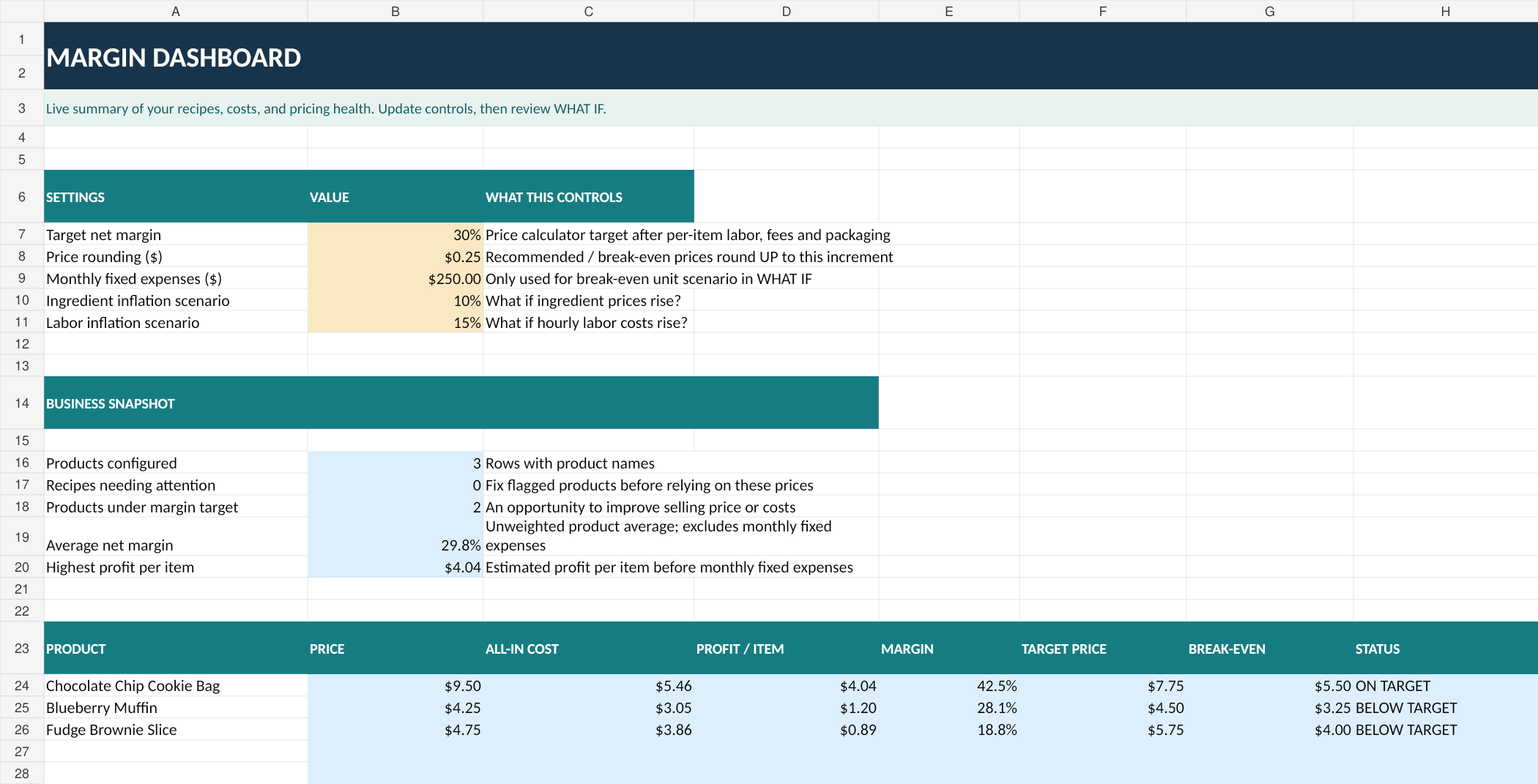
See the Baker’s Margin Lab Excel pricing and profit calculator ($9.90; digital Excel workbook and PDF guide). This is optional: the steps above can also be done with paper or your existing spreadsheet.
All examples are illustrative. Check your own ingredient, labor, tax and payment costs before using any price in your business.